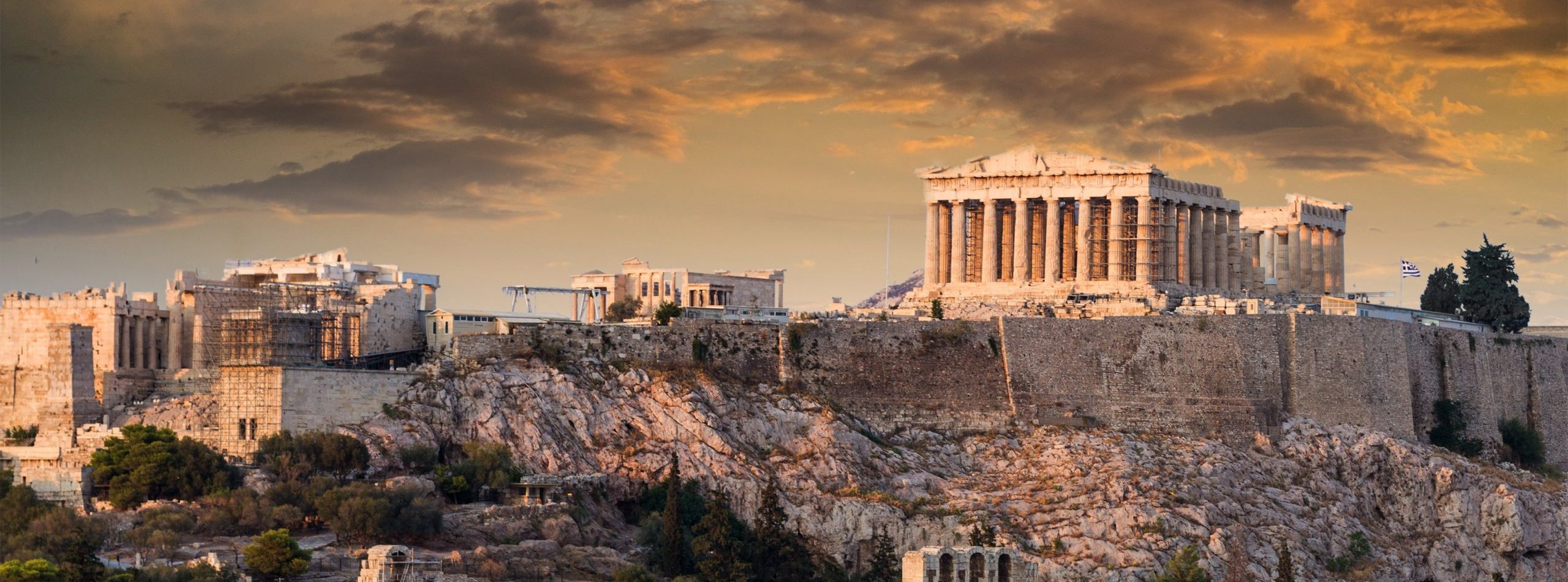


This term our topic is “Groundbreaking Greeks”. Throughout this topic, we will learn about about different periods of Greek history, exploring the earliest civilizations, the devastation of the Dark Age and the breakthroughs and developments of the Archaic and Classical periods. We will get to know some of the most significant Athenians and understand why Greek art, culture, architecture, philosophy, medicine and mathematics were so significant. We will learn about the leadership of Alexander the Great and discover how ancient Greece became part of the Roman Empire after the Hellenistic period. We will explore how the Romans respected and developed Greek ideas, making them their own and spreading them throughout the Roman Empire. To end the project, your child will decide which was the ancient Greeks' greatest idea and explore how the legacy of ancient Greece affects their lives today.
To find out more, view our Groundbreaking Greeks Knowledge Organiser.
(Please refer to the Downloadable Resources Page for PDF copies of all highlighted/underlined documents)

From a geographical perspective, we will learn about the geography of Greece affected the development of city states and explore Athens, learning about the structure of the government and society.
This term our topic is “Groundbreaking Greeks”. Throughout this topic, we will learn about about different periods of Greek history, exploring the earliest civilizations, the devastation of the Dark Age and the breakthroughs and developments of the Archaic and Classical periods. We will get to know some of the most significant Athenians and understand why Greek art, culture, architecture, philosophy, medicine and mathematics were so significant. We will learn about the leadership of Alexander the Great and discover how ancient Greece became part of the Roman Empire after the Hellenistic period. We will explore how the Romans respected and developed Greek ideas, making them their own and spreading them throughout the Roman Empire. To end the project, your child will decide which was the ancient Greeks' greatest idea and explore how the legacy of ancient Greece affects their lives today.
To find out more, view our Groundbreaking Greeks Knowledge Organiser.

Reading
Our Class Text and Comprehension
In term 5 and 6, our reading comprehension will be based upon a fiction text, “Who let the Gods Out?” by Maz Evans. The story is about a troubled boy’s life is turned upside down when an immortal crashes out of the sky onto his barn. They go on adventures together but accidentally release a daemon. With help from the gods, they begin a quest to save the world that takes them to incredible places on Earth and beyond. To find out more about this text, view our Who Let the Gods Out Knowledge Organiser.
For further information about the reading skills we will focus upon this term, please view “Holmes Sequential Reading Curriculum”
Independent Reading
In class, we will continue to use the Accelerated Reader program. For further information about this, please view a Parent's Guide to Accelerated Reader. (https://help.renlearn.co.uk/AR/ARParentGuide) If you need your child's AR password, please contact me (Miss Wood).
Writing
Over the course of the summer term, we will be working on a variety of writing projects related to Ancient Greece and the novel "Who Let the Gods Out?" These projects will allow us to develop our writing skills and explore different forms of writing.
Greek Mythology Non-Chronological Report
We will write a non-chronological report about Greek mythology. Writing non-chronological reports will enable us to utilise a range of layout devices, such as subheadings, bullet points, and tables. We will research Greek Mythology in more detail before planning and writing our own report. Following this, we will choose one Greek myth to study and analyse further which will then form the stimulus of our writing thereafter.
Setting descriptions
Following an in-depth study of our chosen Greek Myth, we will use expanded noun phrases., figurative language and prepositional phrases to write a descriptive setting. A successful setting description allows readers to picture where the story is taking place in their minds whilst they read.
Character Profiles and Diary Entries
We will choose a mythical Greek character and develop our descriptive writing skills by creating character profiles inspired by the myth. Additionally, we will develop empathy and writing skills by imagining and writing diary entries as if we were one of the characters in our Greek myth.
Retelling of a Greek Myth
To conclude our Greek Mythology work, we will retell the story of a Greek Myth from the perspective of a chosen character. We will strive to link paragraphs with cohesive devices and contrast the settings, characters, and atmospheres between the present and the past. Integrating dialogue will bring the characters to life and advance the plot. The use of a variety of verb forms and punctuation will add clarity and emphasis to our writing. Additionally, we will proofread our work to check for spelling and punctuation errors.
Ground breaking Greeks Newspaper Report
We will create a newspaper report about a chosen Greek. The Greeks were famous for their clever thinking and we still remember and use some of their ideas today. Examples are Pythagoras, Aristotle, Hipocrates. We will research a famous ancient Greek and create a newspaper article about their work. Writing a newspaper report encourages children to write impartially in a formal style. It also challenges them to proofread their work as if it were going to print. Children could include specific details and link their information with cohesive devices. Concise noun phrases and a correctly punctuated quotation could also be included.
“Who Let the Gods out?” Formal Letter
Initially, we will use drama to act out the Zodiac Council meeting. We will aim to make it as dramatic as you can. As a part of our development of formal letter writing skills, we will then write a formal letter from the Zodiac Council about why they have taken Virgo’s powers.
“Who Let the Gods Out?” Playscript
We will imagine that Athene had come instead of Aphrodite. We will then re-write this scene as a playscript to show this. Within our playscript we will take account of adverbial prompts, stage directions, and dialogue.
Grammar, Punctuation and Spelling
Punctuation
This term, we will revise the use of apostrophe for omission and possession; write dictated sentences which require decisions regarding punctuation; revise how to punctuate parenthesis; discuss, highlight and analyse a range of punctuation in texts; use commas for all its purposes; and revise the meaning of ambiguity.
Grammar
This term, we will revise conjunctions; work on maintaining consistency of tense when writing fiction and non-fiction texts; revise the use of relative clauses to add information; identify present and perfect tense verb forms; identify commands and questions; write a variety of sentence types when writing dialogue; and continue to practice writing both formal and informal text types.
Spellings
Following the Read Write Inc spelling scheme, during our spelling lessons we will investigate how the sound ‘shul’ can be spelt ‘-cial’ or ‘-tial’ before consolidating the different rules we have learnt throughout the year and focusing on the Orange Words (the year 5 and 6 statutory spelling words).
For an overview of our weekly breakdown of our spellings, please view our Term 5 and Term 6 Homework Grids.
For an overview of the Year 5 and 6 statutory spellings, please view the Spelling word list for Year 5 and Year 6.

Following the White Rose Maths scheme, Holmes class will cover six main blocks of learning over the course of the summer term: shape; position and direction; decimals; negative numbers; converting units; and volume. As part of the White Rose Maths scheme, each block is broken down into a series of small learning steps. Combined, these small learning steps then cover all the curriculum content your child needs to know in small, related chunks.
This term’s small learning steps for each block
| Maths area of learning | Block | Small Learning Steps |
| Geometry | Shape | Understand and use degrees; classify angles; estimate angles; measure angles up to 180°; draw lines and angles accurately; calculate angles around a point; calculate angles on a straight line; lengths and angles in shapes; regular and irregular polygons; and 3D shapes. |
| Geometry | Position and Direction | Read and plot coordinates; problem solving with coordinates; translation; translation with coordinates; lines of symmetry; and reflection in horizontal and vertical lines. |
| Number | Decimals | Use known facts to add and subtract decimals within 1; complements to 1; add and subtract decimals across 1; add decimals with the same number of decimal places; subtract decimals with the same number of decimal places; add decimals with different number of decimal places; subtract decimals with different number of decimal places; efficient strategies for adding and subtracting decimals; decimal sequences; multiply by 10,100 and 1000; divide by 10,100 and 1000; and multiply and divide decimals with missing values. |
| Number | Negative Numbers | Understand negative numbers; count through zero in 1s; count through zero in multiples; compare and order negative numbers; and find the difference. |
| Measurement | Converting Units | Kilograms and kilometres; millimetres and millilitres; convert units of length; convert between metric and imperial units; convert units of time; and calculate with timetables. |
| Measurement | Volume | Cubic centimetres; compare volume; estimate volume; and compare capacity. |
One of the most important things for your child to have mastered and maintain is their knowledge of times tables. For an overview of our weekly times tables focus, please view our Term 5 and Term 6 Homework Grid. To complement their work in lessons reinforcing their fluency, recall and commutativity of these timetables, your child will be set a weekly activity to complete as part of their homework on Sumdog.
Our Calculation Policy: addition and subtraction
Our Calculation Policy: multiplication and division

This term our topic is “Properties and Changes in Materials”. In this project, your child will revisit prior learning about the properties of materials. We will plan and carry out tests to determine the properties of a range of materials and use our results to suggest suitable materials for different purposes. We will learn about the property of thermal conductivity and identify materials that are thermal conductors and insulators. We will investigate which materials are soluble and insoluble. We will find out about heterogeneous and homogeneous mixtures and will separate heterogeneous mixtures using sieving and filtration. We will also separate homogeneous mixtures, investigating how to reverse dissolving by evaporation. We will learn the difference between reversible and irreversible changes and. To find out more, view our Properties and Changes in Materials Knowledge Organiser.
Properties and Changes in Materials Lesson Overview
| Lesson | Learning focus |
| 1 | Properties of Materials – Breadth and depth |
| 2 | Testing Properties |
| 3 | Thermal Conductivity |
| 4 | Measuring Change in Temperature |
| 5 | Testing Thermal Insulators |
| 6 | Solubility |
| 7 | Exploring Mixtures |
| 8 | Exploring Mixtures - Filtering |
| 9 | Exploring Mixtures - Evaporating |
| 10 | Exploring Mixtures - Evaporating |
| 11 | Reversible and Irreversible changes |
Other helpful documents
*Properties and Changes in Materials Glossary
*Properties and Changes in Materials Vocabulary Mat
During Term 5 and 6, we have 3 topics that we will be covering in our Art and D&T lessons.
Art: Mixed Media
Our art topic for this term is “Mixed Media”. Throughout this topic, we will learn about paper crafts, papermaking and collage techniques including paper, fabric, mixed media and photo collage. They will use their learning to create a final piece of small-scale, mixed media collage. To find out more, view our Mixed Media Knowledge Organiser.
Art: Expression
Our second art topic this term is “Expression”. This topic teaches children about the Expressionist art movement and the ‘Father of Expressionism’, Edward Munch. They explore different ways to portray feelings and emotions in art to create an imaginative self-portrait. To find out more, view our Expression Knowledge Organiser.
Design and Technology: Architecture
Linked to our main topic, “Ground-breaking Greeks”, our Design and Technology topic for this term is “Architecture”. Over the course of this project, we will learn how architectural style and technology has developed over time and then use this knowledge to design a building with specific features. To find out more, view our Architecture Knowledge Organiser.

Following the Purple Mash scheme of learning, our two main computing topics, this term, will be 3D Modelling and Processing.
3D Modelling
In term 5, we will be focusing upon 3D Modelling. We will learn about:
- How to use 2Design and Make
- Exploring the effect of moving points when designing
- Designing a 3D model to fit a certain criteria
- Refining and printing a 2D net to turn into a 3D model
To find out more, view our 3D Modelling Knowledge Organiser.
Processing
Over the course of term 6, our work will focus upon word Processing. We will learn:
- How to make a document from a blank page
- How to insert images: considering copyright
- How to edit images using Google Docs and how to wrap text
- To change the look of the text within a document
- To add features to a document to enhance its look and usability
- How to use the sharing capabilities in Google Docs
- To use tables to present information
- To use templates and edit appropriately
To find out more, view our Processing Knowledge Organiser.

Our Religious Education lessons will continue to be based upon our “Love to Celebrate” projects. Basing the “Love to Celebrate” projects around festivals, gives a real-life context to the children’s learning and a structure to the projects. However, the celebration itself is only a small part of each “Love to Celebrate” project. Each set of projects covers all major aspects of each religion including worship, belief, leadership and belonging.
Please view our “World festivals and Celebrations Calendar”.
Term 5: Christianity - Pentecost
Pentecost is celebrated 50 days after Easter. According to the Bible, Jesus had ascended into heaven 10 days earlier and the disciples were waiting to receive power from God to help them spread Jesus’ message. When the Holy Spirit filled the disciples, they started speaking in different languages so that the people in the crowd could understand them. That day, 3000 people were baptised as Christians, therefore Pentecost is seen as the birthday of the Christian church.
Today, Pentecost is a popular time for Baptism and confirmation services. Church leaders may wear red to represent the flames that settled on the heads of the disciples and some churches may also serve a special cake after the Sunday service to mark the birthday of the church. For the key words and vocabulary associated with this topic, please view our "Pentecost Glossary”.
Term 6 Sikhism – Guru Arjan Gurpurab
Gurpurab's are special celebration days that commemorate the lives of the Sikh Gurus. Guru Arjan achieved many things during his lifetime. He completed the Golden Temple in Amritsar in 1604 and promoted the Sikh principle of Dasvandh, giving 10% of earnings to help others as an act of service to God who Sikhs call Waheguru. He also collated the hymns and teaching of the first five Gurus and created the Adi Granth, the book that would eventually become the Guru Granth Sahib. Guru Arjan also became the first Sikh Guru to be martyred for his faith.
Many Sikhs remember Guru Arjan by attending special serviced in the Gurdwara and serving cooling drinks to others. This reminds them of the thirst Guru Arjan must have suffered and his cool and calm nature as he faced death. For the key words and vocabulary associated with this topic, please view our “Guru Arjan Gurpurab Glossary”.

Over the course of term 5 and 6, we will continue to follow our Jigsaw PSHE scheme of learning. Jigsaw, the mindful approach to PSHE is a progressive and spiral scheme of learning. In planning the lessons, Jigsaw PSHE ensures that learning from previous years is revisited and extended, adding new concepts, knowledge and skills, year on year as appropriate.
For more information regarding the knowledge and skills progression, please view the "Jigsaw Knowledge Skills and Progression Document for ages 9-10".
Term 5: Relationships
In this Puzzle, we will learn more about friendships and how to be safe with online communications. We will explore our own and others characteristics and qualities and how this can impact friendships. We will discuss how to solve friendship problems when they occur and how being responsible online can impact this. We will learn about respect and how to ensure other people feel included and part of a group. We will talk about online gaming and how age restrictions are in place. With this, we will discuss how to recognise when gaming is becoming unsafe. Lastly, we will consider what makes a good relationship and how we can help others if they are upset.
Term 4: Changing Me
In this Puzzle, we will learn about self and body image, puberty in boys and girls and the changes that will happen; we will reflect on how they feel about these changes. The children also learn about conception and that sometimes people need IVF to help them have a baby. We will discuss worries about changes and how some changes within puberty bring increased responsibilities such as washing more often. We will also consider looking ahead in different ways and what we are looking forward to when moving to a different class and how to tackle changes.

Following the GetSet4PE scheme of learning, our Physical Education (PE) lessons for term 5 and 6 will focus on athletics, cricket and rounders. Our PE lessons will be on Fridays; children can wear their PE kit into school on this day. Holmes class will also have Forest School on Wednesday’s this term. On their group days, the children can wear their forest school clothes into school.
Athletics
In this unit, pupils are set challenges for distance and time that involve using different styles and combinations of running, jumping and throwing. As in all athletic activities, pupils think about how to achieve their greatest possible speed, height, distance or accuracy and learn how to persevere to achieve their personal best. They learn how to improve by identifying areas of strength as well as areas to develop. Pupils are also given opportunities to lead when officiating as well as observe and provide feedback to others. In this unit pupils learn the following athletic activities: long distance running, sprinting, relay, triple jump, shot put and javelin.
Cricket
Cricket is a striking and fielding game. In this unit pupils develop their understanding of the principles of striking and fielding. They expand on their knowledge of the different roles of bowler, wicket keeper, fielder and batter. In all games activities, pupils have to think about how they use skills, strategies and tactics to outwit the opposition. In cricket, pupils achieve this by striking a ball and trying to avoid fielders, so that they can run between wickets to score runs. Pupils are given opportunities to work in collaboration with others, play fairly demonstrating an understanding of the rules, as well as being respectful of the people they play with and against.
Rounders
Rounders is a striking and fielding game. In this unit pupils develop their understanding of the principles of striking and fielding. Pupils develop the quality and consistency of their fielding skills and understanding of when to use them such as throwing underarm and overarm, catching and retrieving a ball. They expand on their knowledge of how to play the different roles of bowler, backstop, fielder and batter and to apply tactics in these positions. In all games activities, pupils have to think about how they use skills, strategies and tactics to outwit the opposition. Pupils work with a partner and group to organise and self-manage their own games. Pupils play with honesty and fair play when playing competitively.
To find out more, view our GetSet4PE Knowledge Organisers

Our music lessons this year will follow the Sing Up sequential scheme of learning and for Term 5 and 6 we will explore three new topics.
Balinese Gamelan
This unit explores the music of Bali through two dynamic musical forms: gamelan beleganjur – a lively kind of percussion music originally performed during a battle – and the kecak vocal chant. Children will learn about the history and content of both forms, develop an understanding of the repeating cycles that structure almost all Balinese music and explore and perform the interlocking rhythms that underpin both these musical forms,
For more information, please view our Sing Up Balinese Gamelan knowledge organiser.
Composing in Ternary Form
Ternary form (ABA) is a very satisfying musical shape that has been used by composers across many genres for centuries. This unit borrows ideas from a wonderful piece by French composer Maurice Ravel called Laideronnette or Empress of the pagodas, which describes the simple story of a little girl walking through a Japanese forest. Ravel uses only the traditional pentatonic scale in this work, and we will use that as the basis for the unit while also exploring dynamics (volume) and tempo (speed).
For more information, please view our Sing Up Ternary Form knowledge organiser.
Kisne Banaaya
This song from India and Pakistan explores how our world, and the different creatures that inhabit it, came into existence. Pupils will learn choreography to support the learning and understanding of the song (in Hindi), learn to sing the song comparing different performances and play an instrumental accompaniment on tuned percussion.
For more information, please view our Sing Up Kisne Banaaya knowledge organiser.

We are delighted to continue our French lessons with Mrs Cackett, our resident native French speaker. Over the course of the summer term, we will be exploring two new topics: Seasons and Exploring.
Seasons
During this topic, we will explore the months of the year; the 4 seasons; weather patterns; and seasonal poems.
Exploring
This topic focuses on describing a place or a scene. The children will mainly focus on a beach scene but will explore a range of places and use adjectives to add interest and detail to their descriptions. The children will write and perform a poem.
| Year 5 - Term 5 and 6 Resources |
| Title |
|---|