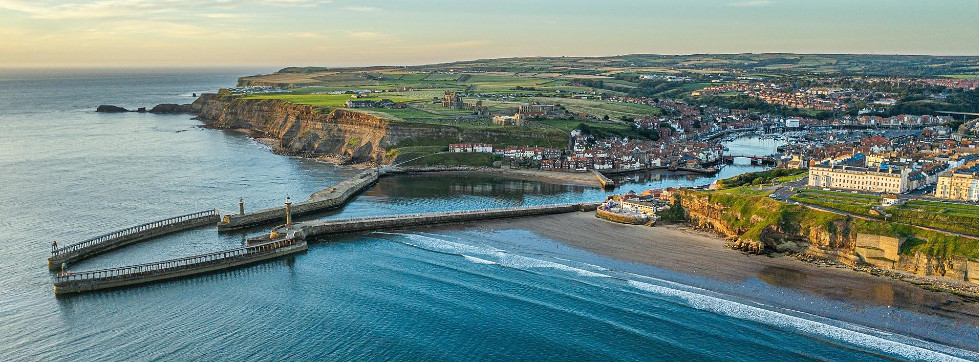


This term our topic is “Coastline”. Throughout this topic, we will learn about the human and physical features of the coastal regions across the United Kingdom, including a detailed case study about Whitby, in Yorkshire.
To find out more, view our Coastline Knowledge Organiser.
Other helpful documents
Coastline Optional Home Learning Tasks
(Please refer to the Downloadable Resources Page for PDF copies of all highlighted/underlined documents)

From a geographical perspective, we will learn about the oceans and seas that surround the United Kingdom; use maps, globes and atlases; learn about the world’s seas and oceans; learn about human and physical features of the coast; learn to use locational language; understand compass directions; discover physical processes such as erosion; and physical changes over time.
Although our topic is mainly a geography focus, we will be looking at two historical aspects around coasts and they are: jobs in the past and significant people – Captain Cook.

Reading
Our Class Text and Comprehension
In term 3, our reading comprehension lessons will be based upon our class text, “Katie Morag and the New Pier” by Mairi Hedderwick. Throughout this fiction text, we will join Katie Morag and her family explore the new pier that has been built in their coastal town. Everyone is ecstatic about the pier other than one face on the island who doesn’t seem so keen…
In term 4, our reading comprehension will be based upon another fiction text called “The Lighthouse Keeper’s Lunch” by Ronda and David Armitage. This story is about a lighthouse keeper called Mr Grinling. He lives in a beautiful white cottage on top of cliffs that are extremely high. He enjoys tucking in to his delicious lunch that his wife makes for him, but he’s not the only one who enjoys his lunch. The seagulls do too!
In term 4, we will also be looking at poems based around Easter for our class assembly.
To find out more about this text, view our Katie Morag and the New Pier Knowledge Organiser.
For further information about the reading skills we will focus upon this term, please view “Darwin Sequential Reading Curriculum”
Independent Reading
In class, we will continue to use the Accelerated Reader program. For further information about this, please view a Parent's Guide to Accelerated Reader.(https://help.renlearn.co.uk/AR/ARParentGuide) If you need your child's AR password, please contact me (Miss Lett).
Writing
Over the course of the term, we will be writing a description; adventure narratives; non-chronological reports; and persuasive writing.
Firstly, we will write a coastal themed description. Writing descriptions are always a great way to use amazing adjectives, noun phrases and a range of punctuation to set the scene. We will also focus on using the past tense consistently.
We will also write an adventure narrative which teaches children all about how to structure a story whilst using amazing vocabulary to keep everyone on their toes. Our adventure narrative will be written in first person about a sea rescue.
Furthermore, we will be writing a non-chronological report about Whitby in Yorkshire. We will be learning how to organize information into sections with sub-headings and using commas in a list.
In term 4, we will have a go at rewriting the story of, “The Lighthouse Keeper’s Lunch” and write a newspaper report about a lost lunch! We will use story maps to help us.
Grammar, Punctuation and Spelling
Punctuation
This term we will learn to use a comma in a list; identify where full stops and capital letters go; and will learn to use apostrophes for contraction.
Grammar
Over the next two terms, we will learn to continue to work on adjectives and nouns; introduce verbs in context; distinguish the difference between facts and fiction; use conjunctions to join sentences; introduce “ly” words; independently; and irregular past tense verbs. We will have a big focus on reading back our work to ensure it makes sense grammatically. We will also look at expanded noun phrases and prepositions to expand our work.
Spellings
During our spelling lessons this term, we revisit “-ing” and “-er” words; talk about syllables; spell words ending in “y”; continue to build on “wh” words; spell the days of the week accurately; common expectation words; numbers one to ten; practise plurals with “s” and “-es”; introduce third person verbs such as: he sings, she plays; and revise “split diagraphs”.
To view our weekly breakdown of our spellings, please view our Term 3 and Term 4 Homework Grid.
In addition to these weekly spelling rules, we will continue to learn and spell words from the Year 2 spelling list. For an overview of these spellings, please view the Spelling word list for Year 2
Following the White Rose Maths scheme, Year 2 will cover four main blocks of learning over the course of the spring term: number (including the four operations); statistics; geometry; and measurement. As part of the White Rose Maths scheme, each block is broken down into a series of small learning steps. Combined, these small learning steps then cover all the curriculum content your child needs to know in small related chunks.
This term’s small learning steps for each block
| Maths area of learning | Block | Small Learning Steps |
| Number | Place Value | |
| Number | Addition and subtraction | |
| Number | Multiplication and division | Recognise equal groups; make equal groups; add equal groups; introduce the multiplication symbol; multiplication sentences; using arrays; make equal groups – grouping; make equal groups - sharing; the 2 times tables; doubling and halving; odd and even numbers; the 10 times tables; divide by 10; the 5 times tables; and divide by 5. |
| Statistics | ||
| Geometry | Shape | |
| Geometry | Position and direction | |
| Measurement | Money | Count money in pence; count money in pounds; choose notes and coins; make the same amount; compare amounts of money; calculate with money; make a pound; find change; and two step problems. |
| Measurement | Length and height | Measure in centimetres; measure in metres; order length and height; and four operations with length and height. |
| Measurement | Mass, capacity and temperature | Compare mass; measure in grams; measure in kilograms; four operations with mass; compare volume; measure in millimetres; measure in metres; four operations with volume and capacity; and temperature. |
| Measurement | Time |
One of the most important things for your child to have mastered and maintain is their knowledge of times tables. For an overview of our weekly times tables focus, please view our Term 3 and Term 4 Homework Grid.
Our Calculation Policy: addition and subtraction
Our Calculation Policy: multiplication and division
In term 3 our topic is “Uses of Material”. Throughout this topic we will find out about different materials, how they move and if they change shape. We will learn to make predictions, carry out experiments and then draw or write up the results.
Uses of Materials Lesson Overview
| Lesson | Learning focus |
| 1 | Exploring every day materials |
| 2 | Shaping materials |
| 3 | Bending, stretching, twisting and squashing |
| 4 | Linking properties to uses |
| 5 | Testing paper |
| 6 | The problem with material |
To find out more, view our Use of Material Knowledge Organiser, Glossary and Vocabulary Mat.
In term 4 our topic is “Plant Survival”. Throughout this topic we will look at the growth of plants from seeds and bulbs. We will observe the growth of plants firsthand, recording changes over time and identifying what plants need to grow and stay healthy.
| Lesson | Learning focus |
| 1 and 2 | Exploring seasonal plants |
| 3 | Germination investigation |
| 4 | Where do plants like to grow? |
| 5 | What do plants need to grow? |
| 6 | Unusual plants |
To find out more, view our Plant Survival Knowledge Organiser, Glossary and Vocabulary Mat.
Art: Flowerhead
Our art topic for term 3 is “Flowerhead”. Throughout this topic, we will learn about the significant artist - Yayoi Kusama and focus on skills such as: drawing; exploring visual elements; printmaking and; 3d forms.
To find out more, view our Flowerhead Knowledge Organiser.
Design and Technology: Beach Huts
Linking closely to our topic this spring, our unit in DT for term 4 is “Beach Huts”. We will learn about structures with a particular focus on strengthening and joining through various materials.
To find out more, view our Beach Huts Knowledge Organiser.

Route Explorers
This unit allows children to code using the tool, 2Go. Children learn to build simple algorithms to move a screen turtle along routes. They consider direction and distances and create commands.
Key Learning
- To use the direction keys in 2Go to move the turtle along a route.
- To use units of distance along with the direction keys in 2Go to move along a route.
- To write instructions to complete more than one step of a route at once.
- To build up instructions for a longer route.
Questioning
In this unit, children will explore how to ask questions to collect useful information. They will learn to organise data using tally charts, pictograms, and simple branching databases to help sort and identify objects.
Key Learning
- To understand how data can be used to help answer a question.
- To ask an appropriate question, gather data using a tally chart and present it using digital tools.
- To begin to explore how yes or no questions can be used to sort data.
- To understand how branching databases work and practise navigating them to find answers.
Coding
This unit builds on the coding skills and knowledge from Year 1. Children will explore, modify and create programs that includes the use of timers and button objects. They will build on their testing and debugging skills to ensure programs work as expected.
Key Learning
- To create a computer program using an algorithm.
- To understand ways that the collision detection event can be used in a program.
- To design a program that follows a timed sequence.
- To understand that different objects have different attributes (properties).
- To understand the function of button objects in a program.
- To understand the importance of testing and debugging.
To find out more, view our Computing Knowledge Organisers.

Term 3: Sikhism – Anand Kuraj
Over the course of this term we will be learning how Sikhs explore love through their weddings, which are known as “Anand Karaj”. First of all we will share our current knowledge of Weddings that we may have celebrated so we can progress our knowledge of weddings in another religion. We will cover: why weddings are special; why we make promises; Sikh weddings; working as one in a team; exploring love; and create invitations to a Sikh wedding.
Term 4: Judaism – Hanukkah
Hanukkah is the Jewish Festival of Lights. The festival celebrates the victory of Judah Maccabee and his Jewish followers over the Syrian Emperor Antiochus and the miracle of the lamp, which burned for eight days in the regained temple in Jerusalem, even though there was only enough oil for one day's light. Over the course of the term Darwin will look at the importance of lighting candles; Hanukkah stories; Menorah; Dreidel; Hanukkah tradition; and Exploring Miracles.
To find out more, view our Anand Kuraj and Hanukkah Glossaries.

Term 3: Dreams and Goals
In this Puzzle, the children explore setting realistic goals and how they can achieve them. They discuss perseverance when they find things difficult as well as recognising their strengths as a learner. The children consider group work and reflect on with whom they work well and with whom they don’t. They also reflect on sharing success with other people.
Term 4: Healthy Me
In this Puzzle, the children learn about healthy food; they talk about having a healthy relationship with food and making healthy choices. The children consider what makes them feel relaxed and stressed. They learn about medicines, how they work and how to use them safely. The children make healthy snacks and discuss why they are good for their bodies.
To Find out more, view our Jigsaw knowledge and skills progression: Being Me In My World - Ages 6-7

Following the GetSet4PE scheme of learning, our Physical Education (PE) lessons for term 3 will focus on gymnastics and target games.
Our PE lessons for term 4 will focus on net and wall games (tennis) and ball skills. Our PE lessons will be on Mondays and Wednesdays; children can wear their PE into school on both of these days.
Gymnastics
In this unit pupils learn, explore and develop basic gymnastic actions on the floor and using apparatus. They develop gymnastic skills of jumping, rolling, balancing and travelling individually and in combination to create short sequences and movement phrases. Pupils develop an awareness of compositional devices when creating sequences to include the use of shapes, levels and directions. They learn to work safely with and around others and whilst using apparatus. Pupils are given opportunities to provide feedback to others and recognise elements of high-quality performance.
Target Games
Target games are games where players send an object towards a target. In this unit, pupils develop their understanding of the principles of defending and attacking for target games. They develop the skills of throwing, rolling and striking towards a target and are given opportunities to select and apply the appropriate action for the target considering the size and distance of the challenge. They will apply their skills individually, in pairs and in small groups and begin to organise and self-manage their own activities. They will understand the importance of abiding by rules to keep themselves and others safe, learn how to score points and use simple tactics.
Net and Wall
Net and wall games are games where either a net separates the players or a wall is used. The object is to hit the ball over the net and into the court space or against a wall to make it difficult for a partner to return. Examples include tennis, badminton, volleyball, squash. In this unit, pupils develop their understanding of attacking and defending principles in net games such as using a ready position to defend their court and placement of a ball into space. They use and develop skills such as throwing, catching, tracking and hitting a ball. They learn how to score points and how to play to the rules. They work independently, with a partner and in a small group and begin to self-manage their own games, showing respect and kindness towards their teammates and opponents.
Ball Skills
In this unit pupils will develop their fundamental ball skills such as throwing, catching, rolling, hitting a target, dribbling with both hands and feet and kicking. They will look to perform these skills with increasing control and accuracy using co-ordination and balance. Pupils will have the opportunity to work independently, in pairs and small groups.
To Find out more, view our Physical Education knowledge Organiser

Term 3: Grandma Rap
This unit explores beat and rhythm work using crotchets and quavers. Beginning with on-the-spot actions, followed by stepping the durations, stick notation is introduced and pupils go on to create their own 4-beat patterns, which they will loop creating an accompaniment to perform the rap to. This unit also contains the second of three progression snapshots that will be returned to and developed in Term 3 to collect evidence of pupils’ progress.
Term 4: Orawa
Orawa (pronounced ‘Arva’) describes a huge river. As pupils listen to the music, they will imagine the journey of the river through Europe, and make decisions about the scenery and events it passes on its way. They will make a huge piece of art based on the river’s journey and then, borrowing ideas from the composer, invent new music using vocal chants and body percussion.
Trains
This unit is all about modes of transport and specifically train travel. Children will begin by listening and analysing four great pieces of music, each one describing a different vehicle. Then they will discover how composers use volume, speed, and rhythm in their music. Finally, they will create their own transport-inspired pieces.
To Find out more, view our Music Knowledge Organisers
| Darwin Class Term 3 and 4 Resources (Year 2) |
| Title |
|---|