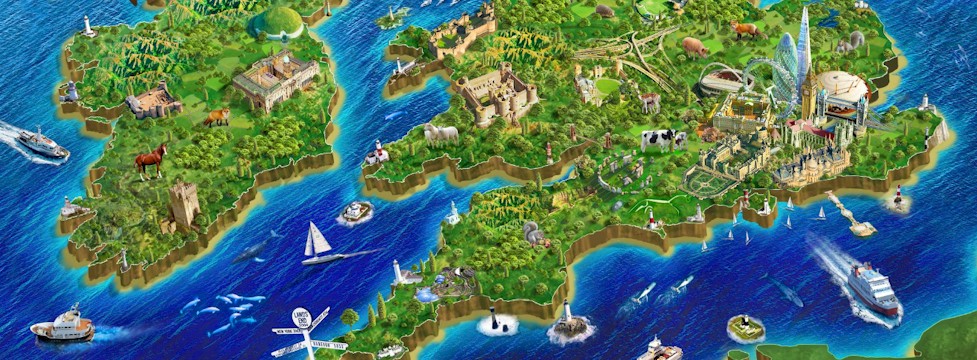

In the Let’s Explore project, your child will explore their class environment and school grounds so that they feel settled and happy in their new surroundings. They will learn about the local environment and find out about places they have visited on holiday. They will look at and create maps for journeys.
Supporting your child at home
- Use Google Earth to explore the locality.
- Go on a walk around your local community and talk about the things that you see.
- Encourage your child to talk about the activities they enjoy doing at school.
- Share and discuss the Did you know? resource.
- You may also like to try some of these Let’s Explore Home Learning tasks.
(Please refer to the Downloadable Resources Page for PDF copies of all highlighted/underlined documents)
Personal, Social and Emotional Development (PSED)
Self-Regulation
The children will, identify and moderate their own feelings socially and emotionally. Think about the perspectives of others.
Managing Self
The children will learn how to effectively manage their own needs. In addition, they will be independent in meeting their own care needs.
Building Relationships
The pupils will start to see themselves as a valuable individual. Throughout this term they will confidently express their feelings and consider the feelings of others.
Example of this in Action:
Term 1 Jigsaw PSHE Topic: Being Me in My World
- In this Puzzle (unit), the children learn about how they have similarities and differences from their friends and how that is OK. They begin working on recognising and managing their feelings, identifying different ones and the causes these can have. The children learn about working with others and why it is good to be kind and use gentle hands. They discuss children’s rights, especially linked to the right to learn and the right to play. The children learn what it means to be responsible.
For more information regarding the knowledge and skills progression, please view the Being Me in My World Knowledge Organiser and Celebrating Differences Knowledge Organiser.
Listening, Attention and Understanding
- Sit on the carpet.
- Be familiar with class rules and begin to follow them.
- Follow simple instructions.
- Begin to answer how and why questions.
- Listen to others retell a simple story.
- Begin to follow 2-part instructions.
Example of this in action:
- In class, we will share the story ‘In Every House, on Every Street’by Jess Hitchman. We will Encourage the children to look closely at the pictures and explore what happens in each room. The children will be supported to make connections with their lives. At the end of the story we will encourage the children to talk about their drawings, and write down what they say on sticky labels.
Speaking
- Hold a conversation with familiar adults and children.
- Use appropriate language in the role play area.
- Retell an event.
Example of this in action:
- In class we will share the story ‘Mr Gumpy's Outing’by John Burningham. As we read the story, the children will be introduced to vocabulary, such as squabble, bleat, trample and tease. The children will be invited to choose a character from the story to play. After rereading the story we will encourage the children to join in using the language from the story.
Gross Motor Skills
At Sandhurst Primary school we use the GetSet4PE programme for all PE lessons. In EYFS the GetSet4PE supports pupils to develop their Gross Motor Skills. In Term 1 and 2, the children will learn to move safely in a space and stop safely. Throughout the unit they will develop control when using equipment and be able to follow a path and take turns. The children will learn to work cooperatively with a partner and develop skills such as; balancing, running, jumping and hopping.
To find out more, view our GetSet4PE Knowledge Organisers
Fine Motor Skills
- To become independent in managing their own needs- dress, undress, use cutlery.
- Copy letters from their name.
- Develop their pencil grip and control.
- Learn how to shape different materials.
- Develop their skills in using small apparatus
Example of this in action:
- Each term, to showcase the children’s development in drawing and painting, they will be invited to complete a self-portrait. The children will be Provided with mirrors, paper, ready-mixed paint and brushes. They will be encouraged to look closely at themselves in the mirror and talk about their eye colour, hair colour and hair length. We will invite the children to paint their portrait and look carefully at their features as they create their artwork. There will also be opportunities for children to explore mixing different colours.
Comprehension
- To use pictures to tell stories
- To sequence familiar stories
- To independently look at book, holding them the correct way and turning pages
- To engage in story times, joining in with repeated phrases and actions
- To begin to answer questions about the stories read to them
- To enjoy and increasing range of books including fiction, non-fiction, poems and rhymes
Word Reading (RWI Phonics)
During Term 1, the children will be introduced to our RWI phonics programme. The term will begin with them learning about the pictures associated with the different sounds. By the end of Term 2, all children should be secure with their Set 1 sounds. The children will learn to blend sounds to read words using taught sounds.
For further information about the reading skills we will focus upon this term, please view “Potter’s Sequential Reading Curriculum” and EYFS and KS1 Phonics Overview
Writing
- To copy their name and to write it independently by the end of Term 2.
- To give meanings to the marks they make
- To copy taught letters
- To write initial sounds
- To begin to write CVC words using taught sounds
- To use the correct letter formation of taught letters
- To write words and labels using taught sounds
- To begin to write captions using taught sounds
For further information about the writing skills we will focus upon this term, please view “Potter’s Sequential Writing Curriculum”.
In EYFS, we follow the NCETM's Mastering Number Programme. In Term 1, pupils will build on previous experiences of number from their home and nursery environments, and further develop their subitising and counting skills. They will explore the composition of numbers within 5. They will begin to compare sets of objects and use the language of comparison.
Pupils will:
- Identify when a set can be subitised and when counting is needed.
- Subitise different arrangements, both unstructured and structured, including using the Hungarian number frame.
- Make different arrangements of numbers within 5 and talk about what they can see, to develop their conceptual subitising skills.
- Spot smaller numbers ‘hiding’ inside larger numbers connect quantities and numbers to finger patterns and explore different ways of representing numbers on their fingers.
- Hear and join in with the counting sequence, and connect this to the ‘staircase’ pattern of the counting numbers, seeing that each number is made of one more than the previous number.
- Develop counting skills and knowledge, including: that the last number in the count tells us ‘how many’ (cardinality); to be accurate in counting, each thing must be counted once and once only and in any order; the need for 1:1 correspondence; understanding that anything can be counted, including actions and sounds.
- Compare sets of objects by matching.
- Begin to develop the language of ‘whole’ when talking about objects which have parts.
Past and Present
- Comment on images of familiar situations in the past.
- Understand the difference between past and present and is building up knowledge of key historical events through topics, stories and community events, e.g. Bonfire Night, Remembrance Day.
Example of this in action:
- The children will have to chance to explore transport through the ages picture cards. The children will be encouraged to discuss how the vehicles have changed and developed over time.
People, Cultures and Communities
- Talk about members of their immediate family and community
- Name and describe people who are familiar to them.
- Listen carefully to stories about different places and is beginning to recognise that different places have different features, e.g. recognising the difference between life in this country and other countries.
- Know about some celebrations and is able to talk about how they might be celebrated, e.g. Christmas, Advent, Diwali
Example of this in action:
The children will explore the let's explore picture cards, postcards from places worldwide and holiday brochures. They will learn that places around the world have different weather, living things and environments. The children will be invited to describe the pictures and compare the locations to their local environment.
The Natural World
- Draw information from a simple map
- Explore the natural world around them.
- Describes some features of plants and animals and identifies when things are the same and different.
- Notices, observes and talks about seasonal changes
Example of this in action:
- The children will be provided with tubs and buckets of different materials in which the children can dig holes and tunnels. Wet sand, soil, gravel, sawdust and clay will be offered to them to explore. They will be provided with a range of digging tools, such as forks, trowels, spoons, small spades and rakes. As a term they will identify the best materials in which to make holes and tunnels.
Creating with Materials
The children will learn how to create collaboratively, sharing ideas, resources and skills. Throughout the term they will develop storylines in their pretend play.
Example of this in action:
- We will Share the story ‘My Cat Likes to Hide in Boxes’ by Eve Sutton. We will Explore rhyming words in the story. As a class, we will explore the different boxes in which the cat likes to hide. On display will be a selection of large boxes and the children will be encouraged to work together to make dens using the boxes. The children will be provided felt tip pens, fabric, large pegs and cushions so they can make the spaces cosy. With support, the children will be encouraged to communicate their ideas, share the resources and cooperate with each other as they create.
Being Imaginative and Expressive
In Term 1 and 2, the children will explore listening and responding to different styles of music, embedding foundations of the interrelated dimensions of music, listening to, learning to sing or sing along with nursery rhymes and action songs, improvising leading to playing classroom instruments and, sharing and performing the learning that has taken place.
Example of this in action:
- Our Sing Up music topic for term 1 is ‘I’ve got a Grumpy Face’ and ‘The Sorcerer’s Apprentice’.
Objectives: Make up new words and actions about different emotions and feelings, Explore making sound with voices and percussion instruments to create different feelings and moods, Sing with a sense of pitch, following the shape of the melody with voices and mark the beat of the song with actions. - Our Sing Up music topic for term 2 is ‘Witch, Witch’ as well as performing songs for our Christmas Nativity show.Objectives: Make up a simple accompaniment using percussion instruments, use the voice to adopt different roles and characters and match the pitch of a four-note (la-so-mi-do) call-and-response song.
| Potter Class - Resources |
| Title |
|---|
| Potter Class Homework | |
 |
Term 1 Homework |