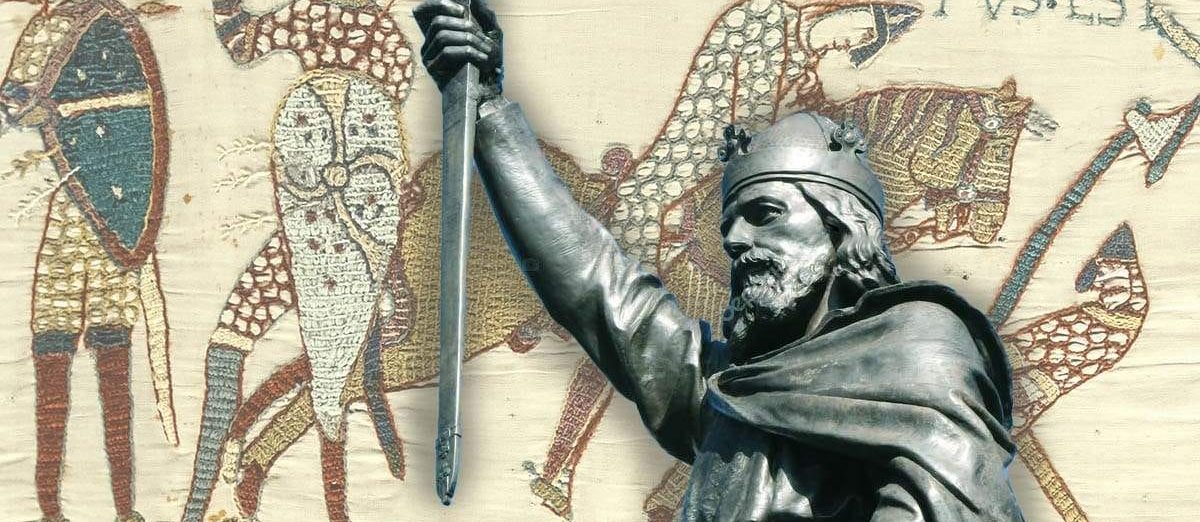


This project teaches children about life in Britain after the Roman withdrawal. Children will learn about Anglo-Saxon and Viking invasions up to the Norman conquests.
To find out more, view our Invasion Knowledge Organiser
Other helpful documents
Invasion Optional Home Learning Tasks
Invasion Civilizations Vocabulary Mat

Children will learn about compass points and four and six-figure grid references. They will learn about the tropics and the countries, climates and culture of North and South America. Children will identify physical features in the United Kingdom and learn about the National Rail and canal networks.
From a historical perspective, we will learn about Roman withdrawal from Britain; the chronology of invasion; Anglo-Saxon, Viking and Norman invasions, everyday life and Anglo-Saxon and Viking Britain; kingdoms, beliefs customs and religion and King Athelstan.

Reading
Our Class Text and Comprehension
In terms 1 and 2, our reading comprehension lessons will be based upon our class text, “The Dragon's Hoard: Stories from the Viking Sagas” by Lori Don.
Whilst reading we will meet the Vikings and enter their enchanting world full of warriors and battles, heroes and heroines, Berserkers, monsters and zombies, and of course, lots of magic. A fantastic introduction to Viking mythology, these tales will have children captivated.
For further information about the reading skills we will focus upon this term, please view “Shakespeare’s Sequential Reading Curriculum”
Independent Reading
In class, we will continue to use the Accelerated Reader program. For further information about this, please view a Parent's Guide to Accelerated Reader. (https://help.renlearn.co.uk/AR/ARParentGuide) If you need your child's AR password, please contact me (Mrs Bromfield).
Writing
Over the course of the term, we will be using “The Saga of Erik the Viking” by Terry Jones, to inspire writing character & setting descriptions, a saga, a playscript, and a poem, all based on based on Norse myths. A Viking warrior and leader called Erik goes on a voyage to find the land where the sun goes at night. Journeying on their ship, Golden Dragon, Erik and his crew encounter many challenges, from mythical creatures and extreme weather to Death himself. Firstly, we will be writing our own Viking Saga. Writing Norse myths can help children understand the purpose behind many of the famous myths we know today. The children will use adjectives to create well-developed characters and settings. They will create a plot that inspires heroic deeds in the face of danger. They will include pronouns, conjunctions and dialogue written as direct speech. They will also start sentences with fronted adverbials.
We will also be writing playscripts. Writing playscripts encourages children to convey characterisation and plot through speech alone. They will present their work in the layout of a playscript, selecting vocabulary to suit different characters. Children will be challenged to specify the delivery of the speech and to vary sentence structures.
Furthermore, we will be writing a poem in the style of Anglo-Saxon poetry. Writing an Anglo-Saxon poem makes children use precise words to suit a particular style. The children will incorporate imaginative descriptions, alliteration, kennings, noun phrases and powerful verbs. They will also edit and improve their work.
For further information about the writing skills, we will focus upon this term, please view "Shakespeare’s Sequential Writing Curriculum"
Grammar, Punctuation and Spelling
Punctuation
This term we will revise use of inverted commas (and commas) to indicate direct speech; use commas in a list; use apostrophes for singular and regular plural nouns and irregular plural nouns.
Grammar
This term we will learn to identify common and proper nouns; revise vowels and consonants; determiners; identify and compose a range of sentence types, punctuating appropriately; revise the present perfect / past tense; collect nouns made from verbs using the suffixes; identify direct and indirect speech; use collective nouns; pronouns; expanded noun phrases; identify and use main clauses and subordinate clauses and revise past tense verbs.
Spellings
During our spelling lessons this term, we will learn how to spell; adding the prefix mis- and revising un-, in-, dis-; words ending in zhuh spelt -sure; the short u sound spelt ou; adding the prefix auto-; adding the suffix -ly; adding the prefix inter-; words with ay sound spelt eigh, ei, ey; words ending in -ous; possessive apostrophe; words ending in zhun spelt -sion; adding il and revising un-, in-, mis-, dis-; and Year 3/4 statutory spelling words (orange words).
To view our weekly breakdown of our spellings, please view our Term 1 and Term 2 Homework Grid.
In addition to these weekly spelling rules, we will continue to learn and spell words from the Year 5 and 6 statutory spelling list. For an overview of these spellings, please view the Spelling word list for Year 3 and Year 4.
Following the White Rose Maths scheme, year 5 will cover six main blocks of learning over the course of the summer term: shape; position and direction; decimals; negative numbers; converting units and volume. As part of the White Rose Maths scheme, each block is broken down into a series of small learning steps. Combined, these small learning steps then cover all the curriculum content your child needs to know in small, related chunks.
This term’s small learning steps for each block
| Maths area of learning | Block | Small Learning Steps |
| Number | Place Value | Represent numbers to 1000; partition numbers to 1000, number line to 1000, thousands; represent numbers to 10,000; partition numbers to 10,000; flexible partitioning of numbers to 10,000; find 1, 10, 100, 100, 1000 more or less; number line to 10,000; estimate on a number line to 10,000; compare numbers to 10,000; order numbers to 10,000; Roman numerals; round to the nearest 10, round to the nearest 100; round to the nearest 1000 and round to the nearest 10, 100 or 1,000. |
| Number | Addition and subtraction | Add and subtract 1s, 10s, 100s and 1000s; add up to two 4-digit numbers – no exchange; ass two 4-digit numbers – one exchange; add two 4-digit numbers – more than one exchange; subtract two 4 – digit numbers – no exchange; subtract two 4 – digit numbers – one exchange; subtract two 4 – digit numbers – more than one exchange; efficient subtraction; estimate answers and checking strategies |
| Measurement | Area | What is area; count squares; makes shapes and compare areas. |
| Number | Multiplication and division A | Multiples of 3; multiply and divide by 6; 6 times-table division facts; multiply and divide by 9; 9 times-table division facts; the 3, 6 and 9 times-tables; multiply and divide by 7; 7 times-table and division facts; 11 times-table and division facts; 12 times-table and division facts; multiply by 1 and 0; divide a number by 1 and itself and multiply three numbers |
One of the most important things for your child to have mastered and maintain is their knowledge of times tables. For an overview of our weekly times tables focus, please view our Term 1 and Term 2 Homework Grid. To complement their work in lessons reinforcing their fluency, recall and commutativity of these timetables, your child will be set a weekly activity to complete as part of their homework on Sumdog.
Our Calculation Policy: addition and subtraction
Our Calculation Policy: multiplication and division
In term 1 our topic is “Sound”. This project teaches children about sound, how sound is made and how sound travels as vibrations through a medium to the ear. They will learn about pitch and volume and find out how both can be changed. To find out more, view our Sound Knowledge Organiser.
Term 1 Lesson Overview
| Lesson | Learning focus |
| 1 | Sound Facts |
| 2 | Exploring Sound |
| 3 | How does sound travel |
| 4 | How do we hear sound |
| 5 | Muffling sounds |
| 6 | changing the volume and pitch of sounds |
Other helpful documents
In term 2 our topic is “Food and the Digestive System”. This project teaches children about the human digestive system. They will explore the main parts, starting with the mouth and teeth, identifying teeth types and their functions. They will link this learning to animals' diets and construct food chains to show the flow of energy.
To find out more, view our Food and the Digestive System Knowledge Organiser.
Term 2 Lesson Overview
| Lesson | Learning focus |
| 1 | Producers and Consumers |
| 2 | Eco Systems |
| 3 | Food Chains |
| 4 | Changes in habitats |
| 5 | The Digestive System |
| 6 | Teeth |
| 7 & 8 | Planning an investigation, carrying out an investigation on the best type of toothpaste. |
Other helpful documents
Art: Contrast and complement
This project teaches children about colour theory by studying the colour wheel and colour mixing. It includes an exploration of tertiary colours, warm and cool colours, complementary colours and analogous colours, and how artists use colour in their artwork .
To find out more, view our Contrast and Complement Knowledge Organiser.
Design and Technology: Fresh food, good food
Over the course of this project, the children will learn about food decay and preservation. They will discover key inventions in food preservation and packaging, then make examples. The children will prepare, package and evaluate a healthy snack.
To find out more, view our Fresh food, Good Food Knowledge Organiser.
Design and Technology: Warp and weft
This project teaches children about the artform of weaving and how it has developed over time, including the materials and techniques required to create woven patterns and products.
To find out more, view our Warp and Weft Knowledge Organiser.

Online Safety
In our work about online safety, we will learn about:
- Phishing
- Malware
- Plagiarism
- Healthy screen time
To find out more, view our Online Safety Knowledge Organiser.
Coding
In term 1, we will be focussing upon coding. We will learn about:
- Design, code, test and debug
- IF statements
- Co-ordinates
- Repeat Until and IF/ELSE Statements
- Number variables
- Making a playable game
To find out more, view our Coding Knowledge Organiser.
Spreadsheets
Over the course of term 2, our work will focus upon spreadsheets. We will learn:
- Formula wizard and formatting cells
- Using the timer and spin buttons
- Line Graphs
- Using a spreadsheet for budgeting
- Exploring place value with a spreadsheet
To find out more, view our Spreadsheets Knowledge Organiser.
Our Religious Education lessons will continue to be based upon our “Love to Celebrate” projects. Basing the “Love to Celebrate” projects around festivals, gives a real-life context to the children’s learning and a structure to the projects. However, the celebration itself is only a small part of each “Love to Celebrate” project. Each set of projects covers all major aspects of each religion including worship, belief, leadership and belonging.
Please view our “World festivals and Celebrations Calendar”.
Term 1: Buddhism - Kathina
Kathina is a celebration held in October or November after Vassa, the Rains Retreat, which is sometimes known as the Buddhists Lent. Buddhist monks stay in a vihara or monastery during the rainy season in Asian countries and spend time studying the Dharma (Buddha's teaching) and meditating.
For the key words and vocabulary associated with this topic, please view our “Kathina Glossary”.
Term 2: Hinduism - Janmashtami
The festival of Janmashtami celebrates the birthday of Lord Krishna and falls in August or September. Krishna is one of the Hindu faith's most popular gods.
The festival lasts for two days. Worshippers may sing songs, tell stories of Krishna's life, dance, rock his cradle and wait for midnight to arrive to mark his birth. Some Hindus fast during the day of Janmashtami and only eat after midnight.
For the key words and vocabulary associated with this topic, please view our “Janmashtami Glossary”.

Over the course of term 1 and 2, we will continue to follow our Jigsaw PSHE scheme of learning. Jigsaw, the mindful approach to PSHE is a progressive and spiral scheme of learning. In planning the lessons, Jigsaw PSHE ensures that learning from previous years is revisited and extended, adding new concepts, knowledge and skills, year on year as appropriate.
For more information regarding the knowledge and skills progression, please view the Jigsaw Knowledge Skills and Progression Document for ages 8 - 9
Term 1: Being me in my world
In this Puzzle, the children explore being part of a team. They talk about attitudes and actions and their effects on the whole class. The children learn about their school and its community, who all the different people are and what their roles are. They discuss democracy and link this to their own School Council, what its purpose is and how it works. The children learn about group work, the different roles people can have, how to make positive contributions, how to make collective decisions and how to deal with conflict. They also learn about considering other people’s feelings.
Term 2: Celebrating Difference
In this Puzzle (unit), the children consider the concept of judging people by their appearance, of first impressions and of what influences their thinking on what is normal. They explore more about bullying, including online bullying and what to do if they suspect or know that it is taking place. They discuss the pressures of being a witness and why some people choose to join in or choose to not tell anyone about what they have seen. The children share their own uniqueness and what is special about themselves. They talk about first impressions and when their own first impressions of someone have changed.

Following the GetSet4PE scheme of learning, our Physical Education (PE) lessons for terms 1 and 2 will focus on invasion games, athletics and health related fitness. Our PE lessons will be on Tuesday and Thursday; children can wear their PE into school on both of these days.
Invasion Games (Rugby)
In their tag rugby lessons, pupils develop their understanding of the attacking and defending principles of invasion games. Pupils will have to think about how they use skills, strategies and tactics to outwit the opposition. They do this by maintaining possession and moving the ball towards the try line to score.
Health Related Fitness
Pupils will take part in a range of activities that explore and develop different areas of their health and fitness. They will be given opportunities to work at their maximum and improve their fitness levels, recognising how the activities make them feel. They will need to persevere when they get tired or when they find a challenge hard and are encouraged to support others to do the same. Pupils are asked to recognise areas for improvement and suggest activities that they could do to do this, while always working safely and with control.
Sports Hall Athletics
Throughout these lessons, pupils will develop basic running, jumping and throwing techniques. They are set challenges for distance and time that involve using different styles and combinations of running, jumping and throwing. As in all athletic activities, pupils think about how to achieve their greatest possible speed, distance or accuracy and learn how to persevere to achieve their personal best.
Invasion Games (Hockey)
In hockey lessons, pupils develop their understanding of the attacking and defending principles of invasion games. They will learn to do this by maintaining possession and moving the ball towards the goal to score. Pupils will also develop their understanding of the importance of fair play and honesty while self-managing games and learning and abiding by key rules, as well as evaluating their own and others’ performances.
To find out more, view our GetSet4PE Knowledge Organisers

Musically, students are constantly touching upon all key musical elements and skills, building upon these as they progress through each lesson, unit and year. As well as this, there is also a Musical Spotlight to each unit. This by no means indicates that there is only one musical aspect or concept being considered and developed – it just allows one chosen musical element, aspect or skill to come to the fore for contemplation, discussion and development, for the duration of that unit.
Term 1:
“This Little Light of Mine"
Our focus in this module is: the pentatonic scale, Gospel music, off-beat rhythm, and call-and-response
Term 2:
Pink Panther
The learning uses music from a film to focused around: timbre, temp, dynamics, and atmosphere.
Composing with colour
The learning focuses on: triads, chords and chord structure, and folk-rock styles.
For more information, please view our Sing Up Year 4 knowledge organisers

We are delighted to continue our French lessons with Mrs Cackett, our resident native French speaker.
Term 1: On the way to school
Throughout this topic, we will learn: simple greetings; how to make simple statements (about name and age); asking simple questions (about name and age) and numbers 1-10
Term 2: Where in the world is French spoken?
During this topic, we will learn: numbers 11-20; simple questions and expressing preference
| Shakespeare Class Term 1 and 2 Resources |
| Title |
|---|